 LONNOW.COM
LONDON BY AREA
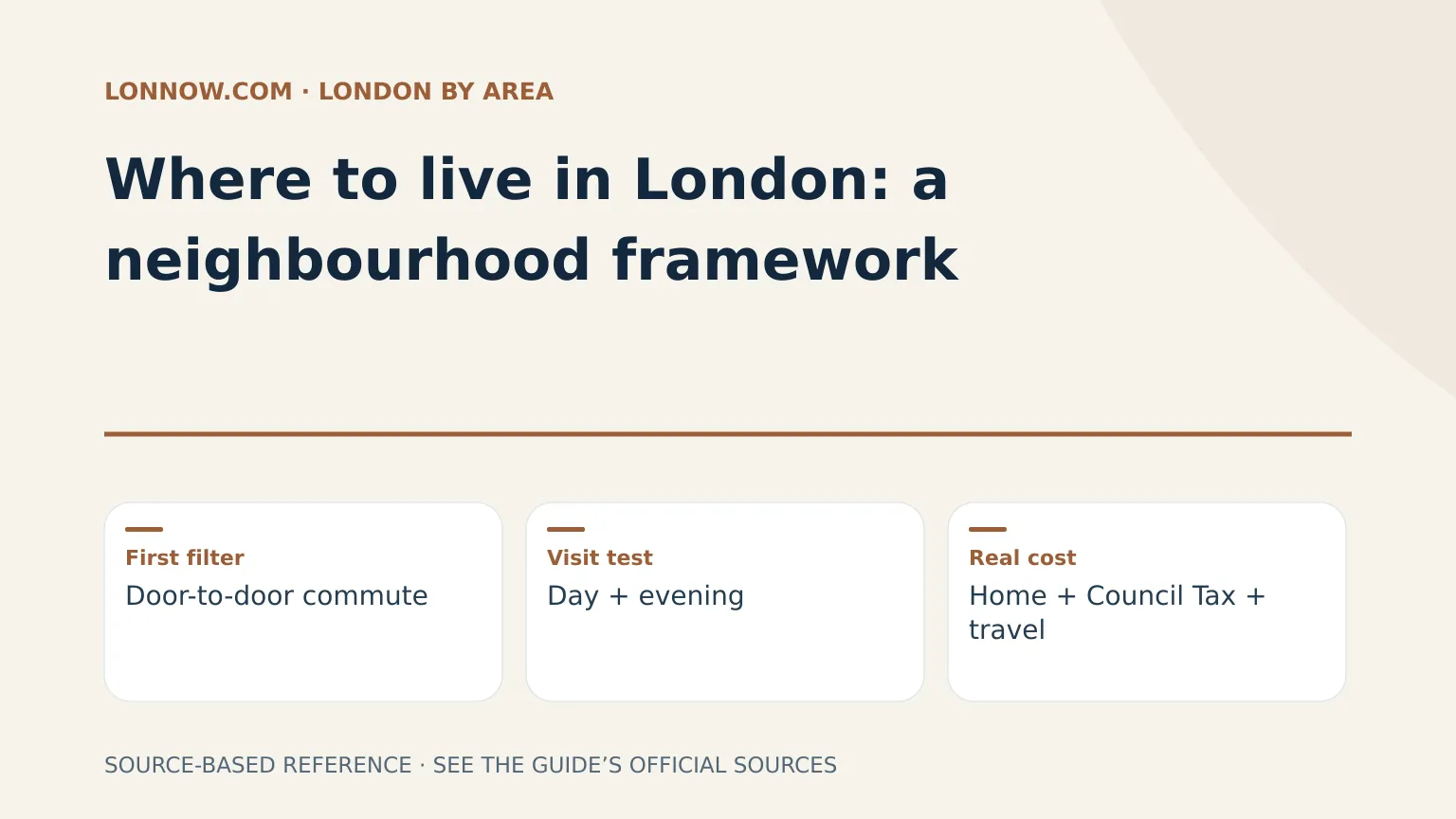
Where to live in London: a neighbourhood framework
The best area is the one that balances your travel pattern, housing budget and daily priorities.
Start with the commute
Compare door-to-door time, late-night options and backup routes rather than distance on a map.
- First filter
- Door-to-door commute
- Visit test
- Day + evening
- Real cost
- Home + Council Tax + travel
- Decision
- Compare routines
On this page
Price the whole home
Add Council Tax, energy, broadband and transport to the advertised rent.
Choose a daily rhythm
Decide whether green space, nightlife, schools, food, quiet streets or weekend walkability matters most.
Every gain changes another part of the equation.
Visit twice
See the area on a weekday evening and at the weekend.
Walk from the station, visit a supermarket and listen to the street before committing.
Build a non-negotiables list
Limit the list to five items such as maximum total housing cost, commute ceiling, minimum bedroom need, step-free access, school requirement or late-night transport.
Rank them before browsing homes. Without this discipline, attractive listings repeatedly reset the decision.
Preferences such as cafés or architectural character matter, but they should not quietly displace a requirement that affects work, safety or household stability.
Compare micro-areas
A neighbourhood name can cover streets with very different noise, gradients, transport access and housing stock.
Test the exact route from the property to the station, shops and essential services. Check the evening atmosphere and the building itself.
Decisions should be made at address level; a positive reputation for the wider district cannot guarantee that a specific block fits the household.
Keep a backup area
Identify a second district that meets the same core needs through a different transport corridor.
This reduces pressure when a tenancy falls through and helps reveal whether you are paying for a famous postcode rather than useful daily advantages. Review both areas with the same scorecard and current listings, because relative value can change quickly even when their general character remains familiar.
Separate visiting from living
A neighbourhood that makes a brilliant Saturday can create a difficult weekday.
For a visit, prioritise the experience, walking route and transport home. For a move, test the commute, groceries, noise, lighting, parks, healthcare and the journey at the hours you will actually use them.
Treat reputation as a hypothesis and daily routine as evidence.
Calculate the address-level cost
Compare rent or mortgage with Council Tax, energy, insurance, travel, parking and the cost of reaching ordinary services.
Borough averages do not price a particular home, and a cheaper postcode can lose its advantage through a longer commute. Use current listings, the property’s documents and official local information before making a financial decision.
Check family and access needs directly
School admissions depend on current rules, places and address evidence; proximity alone does not guarantee entry.
Step-free station maps do not describe every pavement, hill or building entrance. Visit the route, contact the responsible school or venue and verify the exact property.
LONNOW comparisons are a shortlist tool, not a substitute for address-level checks.
Continue exploring
London neighbourhood finder: where should you visit or live?
Match your preferred pace, location and priorities to a shortlist of London areas, then read the full guide before making a visit or housing decision.
Top 5 London neighbourhoods: five places for five different lifestyles
Richmond, Hampstead, Greenwich, Islington and Notting Hill: a curated shortlist built around how you want London to feel.

Bloomsbury: A Visitor’s Area Guide
Make the museum your anchor, then leave room for a short neighbourhood walk and a proper break.